Artist Residencies
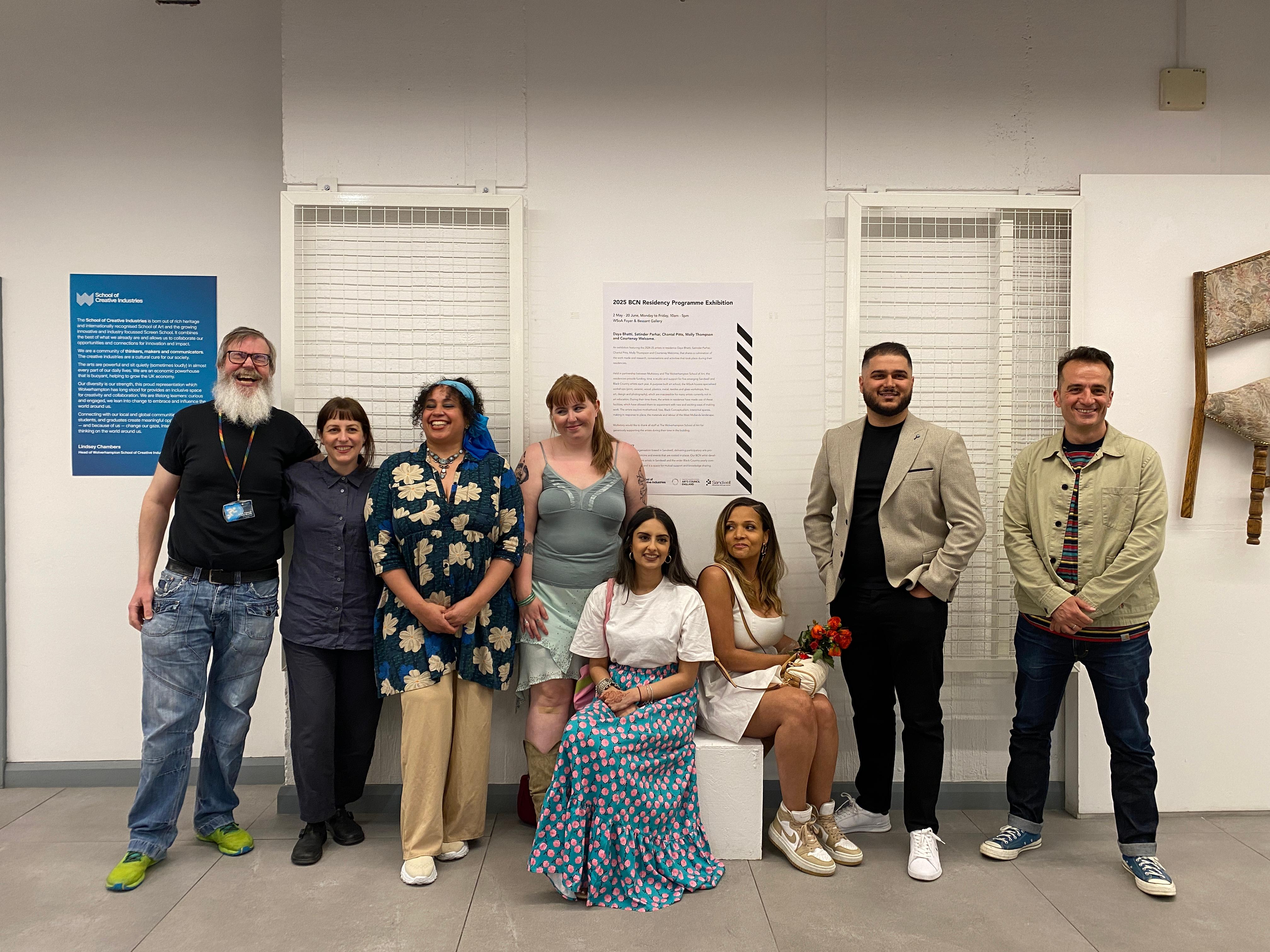
The artists in residence at the end of programme group exhibition launch.
Chantal Pitts, Courtenay Welcome, Daya Bhatti, Molly Thompson, Satinder Parhar.
Produced in partnership between Multistory and The Wolverhampton School of Art as part of Multistory’s artist development programme, the residency supports five emerging Black Country based artists each year with time, space, funding and critical mentorship. The artists’ presence activates the building as a site of exchange between students and the professional art world; opening access to the school's specialist facilities to the wider arts community, while contributing to a multidisciplinary culture of shared learning.
The programme culminates with the sharing of their work in an exhibition in the Wolverhampton School of Art’s foyer space, which is programmed to coincide with the yearly degree show. Rather than presenting work in its final state, the exhibition shares work in progress, reflecting the programme’s commitment to supporting practice as research, and providing space for artistic experimentation and play.
Chantal Pitts
During her residency, Chantal created a new body of work titled Chapter 53, concerning family, love, loss, change and memories. The number 53 relates to Chantal’s current age; with empty nest period looming, the work is an exploration of motherhood, menopause, ageing and the tensions between holding on and letting go. Chantal explored printing onto wood, metalworking, sculpture and assemblage, combining different materials with wood and furniture and using hypnotherapy as part of the process. Each work represents various aspects of the artist’s personal experiences and feelings. They are all a part of the same work, but also stand alone as pieces in their own right, like members of a family. Introversion, a new series of clipboards, is a dissection of the psyche, a breakdown of thoughts and emotions, jumbled and displayed, raw and exposed, yet given space to be seen and acknowledged.
Courtenay Welcome
During their residency Courtenay expanded on their ongoing body of work exploreing the rich complexities of race, memory, space and time, with interests spanning Black Conceptualism, Freedom Dreams, water, care, the role of the artists’ hands and experimental mark making. They explored how they might merge painting and sculpture, and how they can become one through installation. Drawing from Stuart Hall’s Encoding/Decoding model of communication which informed how marks are made and installations are built in space.
Daya Bhatti
For Daya’s residency, she focussed on experimenting with new materials and ways of making work, and initiated a new project titled Sari Stories. Sari Stories delves into the sari beyond its use as a garment, as a symbol rich with cultural, emotional, and historical significance. The work draws upon the sari’s deep connection with South Asian cultural traditions, and ability to transcend borders and travel across different regions. The artist incorporated scent and touch sensors to create interactive experiences that invite viewers to participate in the storytelling. In 'Scent & Memory', scents like sandalwood and turmeric evoke the warmth of home and memory, and the sari becomes a dream space which transports the viewer home. 'Protector' explores the spiritual significance of the sari being a protector of energies, and 'Past & Present' explores the evolution of the sari drape, from its ancient depictions to its modern-day styles. The artist incorporated elements like sound and touch sensors, scent and glow to create interactive experiences that invite viewers to participate in the storytelling.
Molly Thompson
Molly shares a new sculpture informed by a burnt out car she encountered during her walks along the canals. Drawn by the uncanny nature of the site, the artist found herself returning to it again and again to watch the landscape change. The sculpture abstracts and replicates this scene, drawing inspiration from the landscape and what the artist sees as industrial / laborious remains, with the materials dictating the form of the sculpture. The breathing airbags were inspired by the impact of the burnt car. She explored movement, especially breathing and air, aiming to manipulate the non-living into the living. As she completed the work, a new walk revealed that the remains of the car had been taken away - the work transforms into a haunting of what once was.
Satinder Parhar
The focus of Satinder’s residency was to use the school’s facilities to realise a series of large-scale, dry-point prints of ‘empty spaces’ in the local area. The prints displayed play against the pressure for perfectionism in printmaking, and explore what a site-responsive printmaking practice might look like - while using the facilities unusually warm weather meant that the ink was extra sticky, and the print teared. This introduces a performative element to Satinder’s practice - the process of tearing immortalised in the frame etc. The residency also allowed Satinder to explore possibilities for his practice to move towards immersive installation, exploring around the concept of entrapment and spaces with the absence of light. This is the opposite of what he currently produces with his dry-point prints, where it focuses on light, depth, and the ability of placing the viewer in a place to fully immerse themselves in the work. He began to play around with a selection of the world’s blackest paints, which absorb 99.95% of all light - these tests can be seen in the new sculptural pieces shown alongside the prints.
Artist Biographies
Chantal Pitts is an interdisciplinary artist whose current practice encompasses furniture as a medium, installation, assemblage and sculpture with self-hypnosis as part of her practice. Her work is self-reflective, exploring and expressing the intangible self and identity. She has exhibited and been commissioned by, Stryx JQ, the Graves Art Gallery, Sheffield, The Photographer’s Gallery, Soho, London, The Asylum Gallery, Wolverhampton, Stryx Gallery in the Jewellery Quarter, Birmingham. She is a member and co-founder of the AMASS artist collective.
Courtenay Welcome explores the rich complexities of race, memory, space and time, with interests spanning Black Conceptualism, Freedom Dreams, water, care, the role of the artists’ hands and experimental mark making. Their work is informed by revolutionary thought and research around dreams, love, race relations and critically addresses the ways in which these elements are co-opted by institutions. Often working with photography to explore identity construction and lifestyle, the artist disrupts pre-existing ways of looking and thinking about images and objects in space. They experiment with mark making’s relationship to the body and emotions, using repeating motifs such as '● ●' within their work to build a visual language in dialogue with a history of refusal, layering consciousness, perspective, observations of visual culture, external gazes, sensory input and the imagination.
Daya Bhatti's work explores South Asian traditions, histories and the hybrid British Asian identity. Her practice encompasses a wide array of artistic mediums including portraiture, illustration, animations, painting, textiles and the use of recycled materials. Daya is interested in the concept of ‘wearable art’ and often uses clothing as a vehicle for storytelling to blur boundaries between fashion and a visual arts practice. Her interest in merging textiles and art is inspired by the rich storytelling embedded in South Asian textiles, fashion, and craftsmanship. Her work explores the intangible heritage of textiles, as materials which bridge the past, present and possible futures, centering subaltern narratives. She has exhibited in various galleries across the UK (Wolverhampton Art Gallery, Babylon Gallery, St Mary's Guildhall, Peterborough Museum, Wells Maltings, Herbert Art Gallery) alongside facilitating creative workshops and being commissioned by Manchester Museum and Preston Park and Museum.
Molly Thompson's work explores preservation as a tool for recalling lived narratives in conceptual forms, connecting sound, film, and sculptures. By creating ambiguous narratives around personal experiences, she explores memory as fiction and/or phantom. Her practice centers around the materials and labour of the West Midlands landscape. The work is often site-specific and of a temporal nature to capture the vast ever-changing social and physical climate. Using found/existing materials, she repurposes fabricated objects as sculpture to express lived narratives and agendas. The work is a self-portrait abstracted through materiality, creating a discourse between commodity and value.
Satinder Parhar has long produced large scale dry-point prints, which explores the concept of interstitial spaces. Fascinated by natural and man-made apertures; he explores empty spaces such as tunnels, vents, caves, fissures etc. These forms create an intervening space called an ‘interstice.’ It examines the structures, the interstitial spaces formed within and its relationship with the “object.” Do they supplement or oppose each other? The use of black and white emphasises the disparity and the unity between the interstice and interstitial space. The two colours oppose each other, yet work together. The viewer is immersed within this re-representational space through the size of the prints. Both exist in the realm of one another.
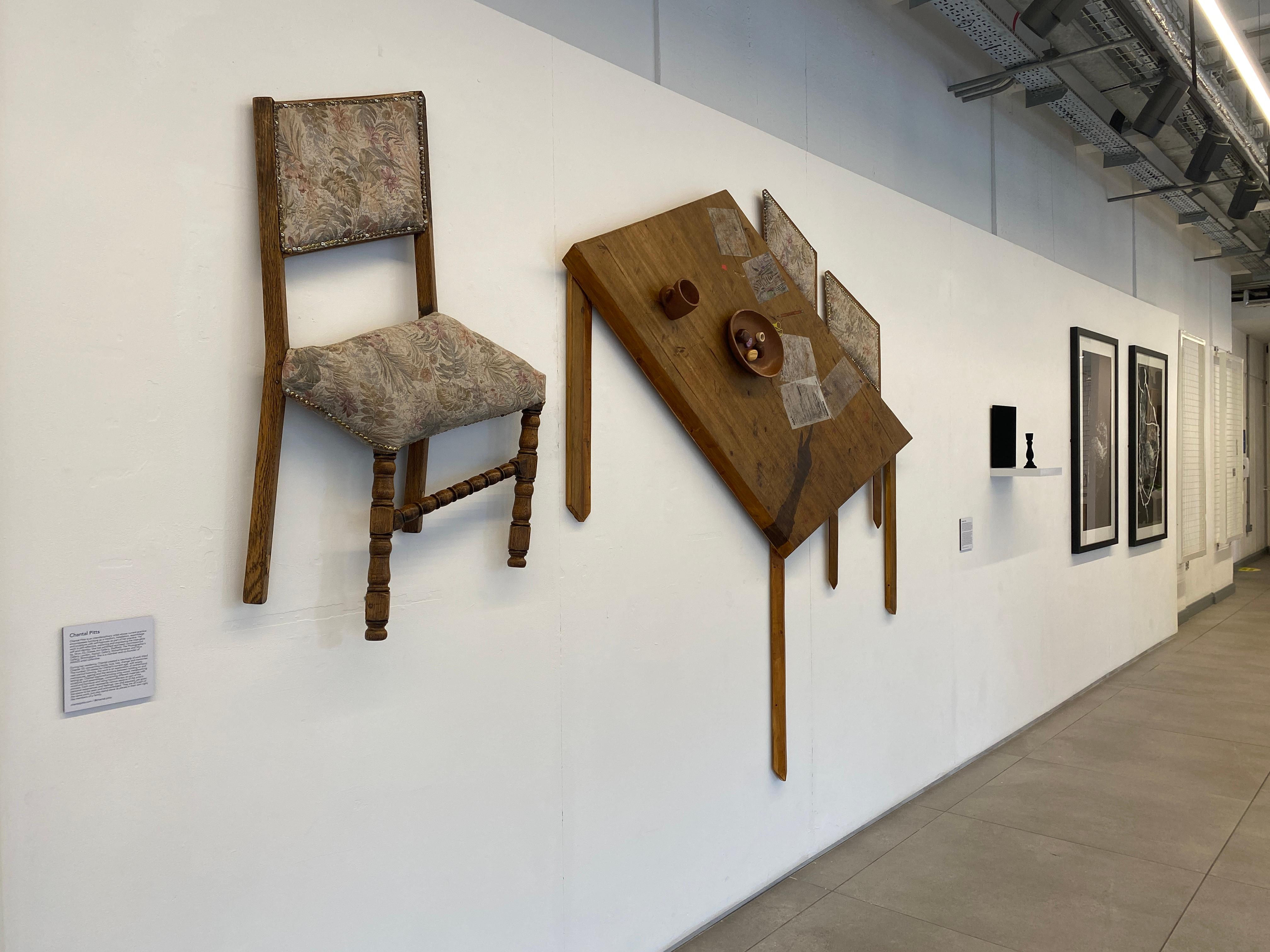
Chantal Pitts.
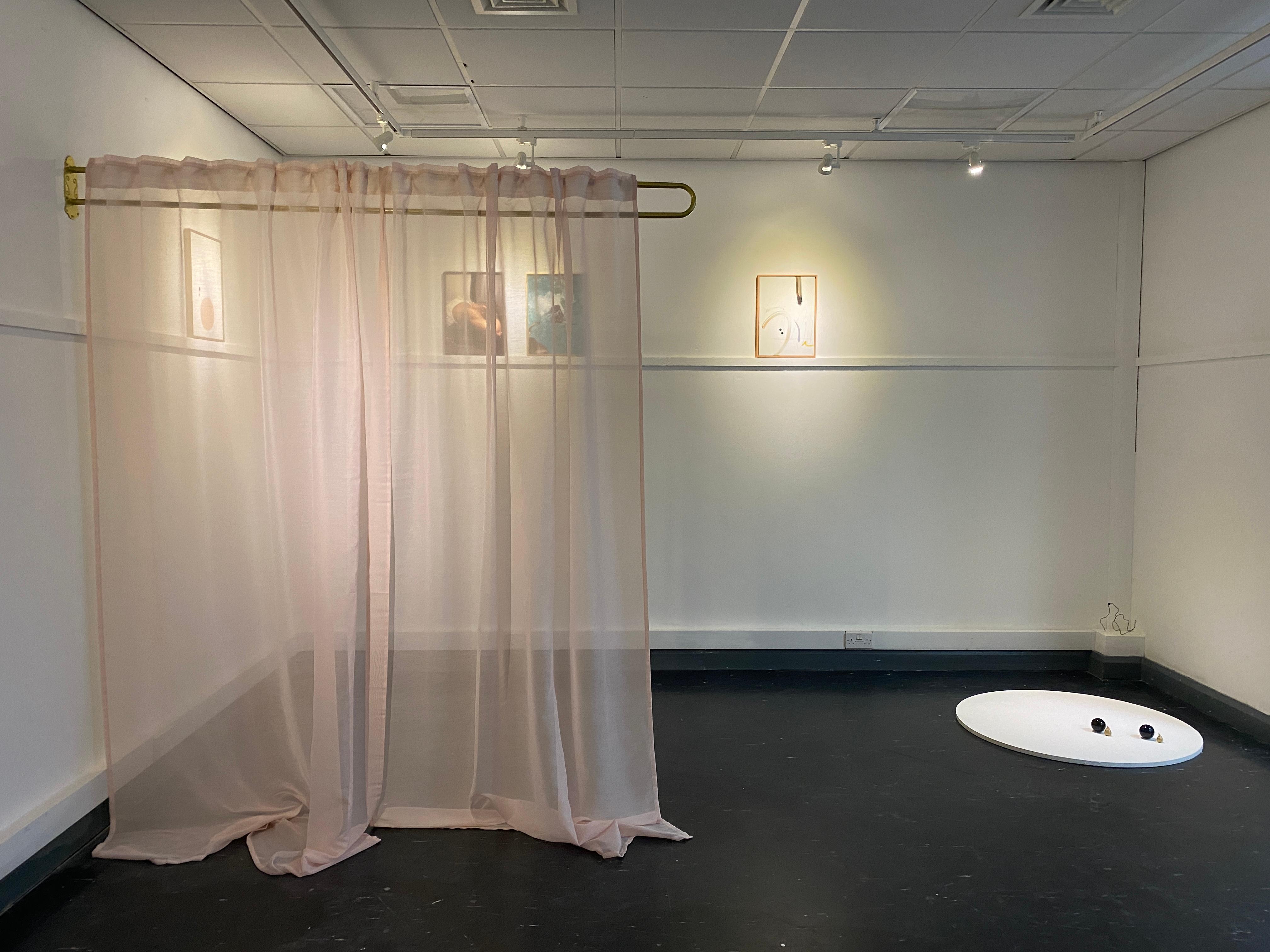
Courtenay Welcome.
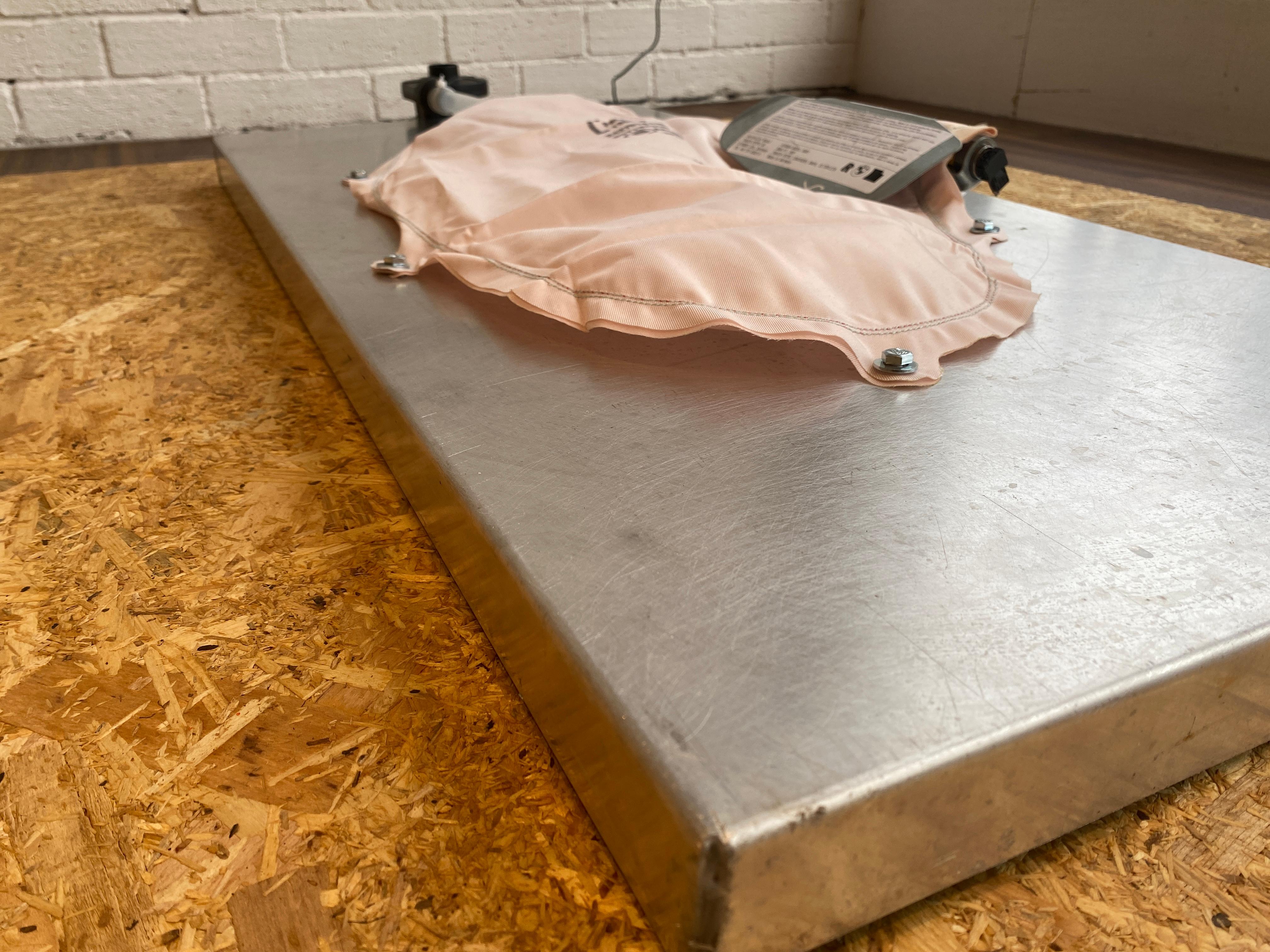
Molly Thompson.
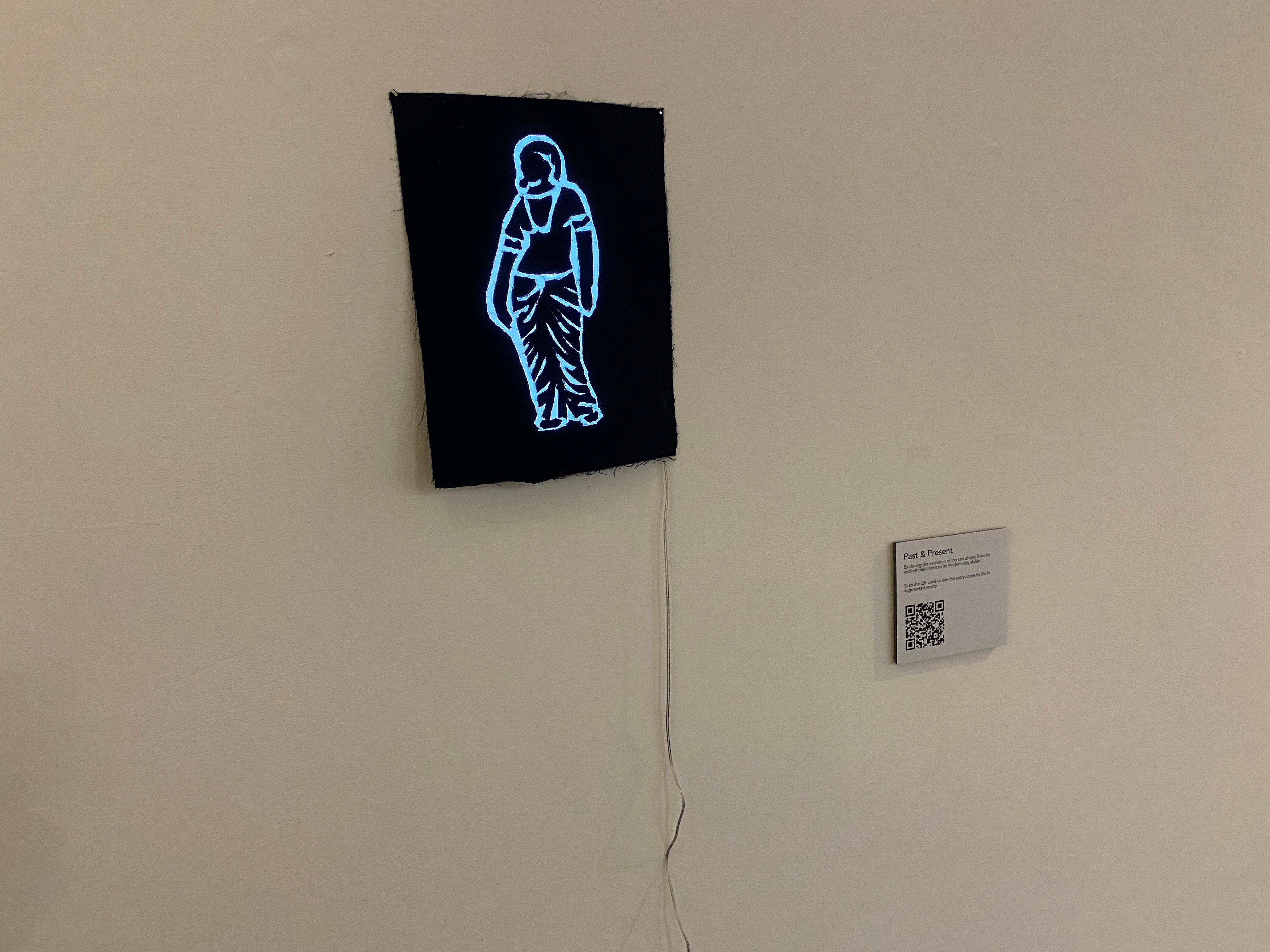
Daya Bhatti.
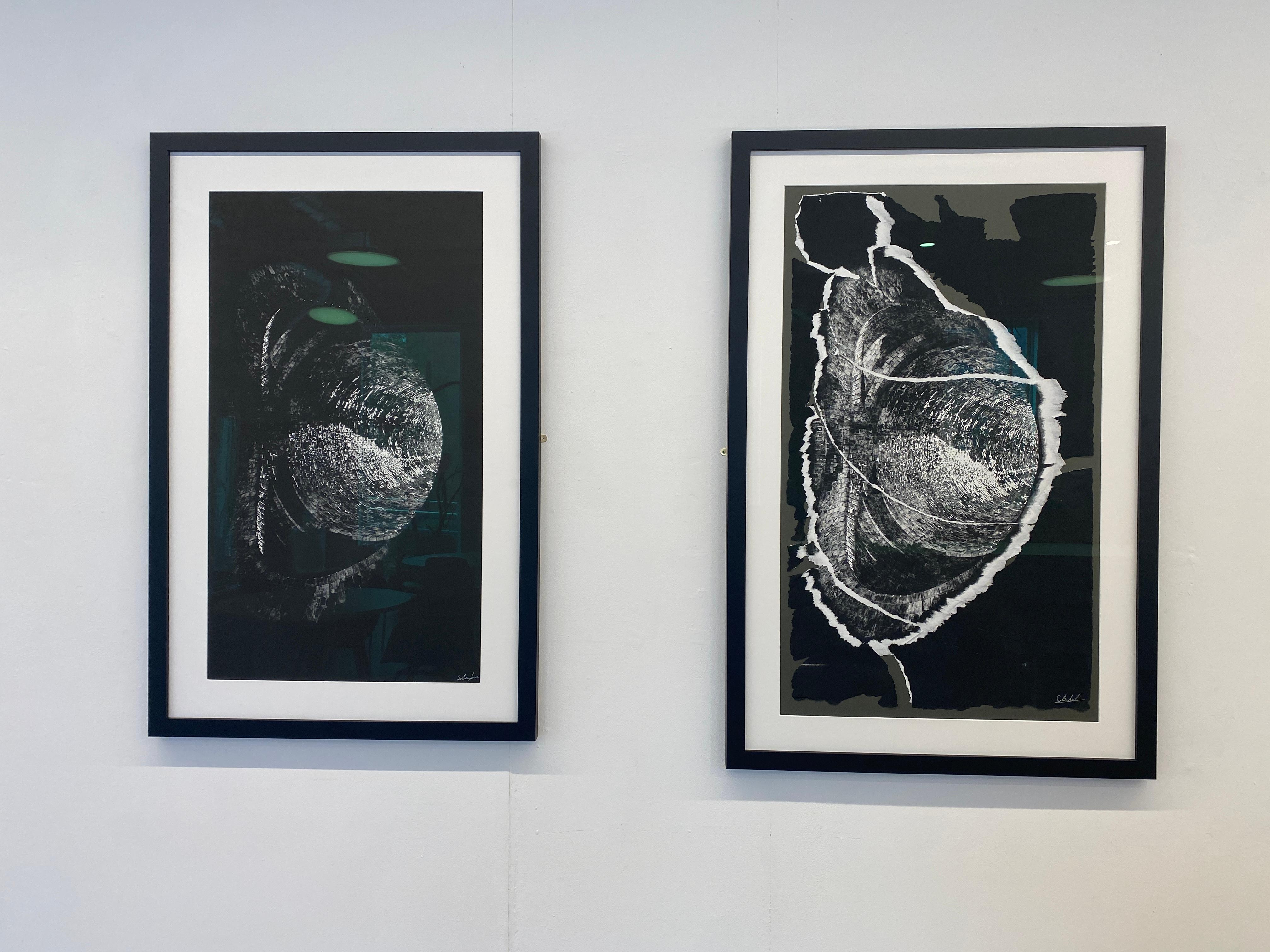
Satinder Parhar.